TOTΛ
https://youtu.be/c88unOzpRKY
Beyond General Relativity and ΛCDM
For thousands of years, humans looked up and saw a fixed stage.
The Sun rose and set.
The planets traced perfect loops.
Our greatest theories—from Ptolemy to Newton to Einstein—were maps of that stage.
They described what we saw with breathtaking precision.
But the stage was moving.
We just couldn't feel it.
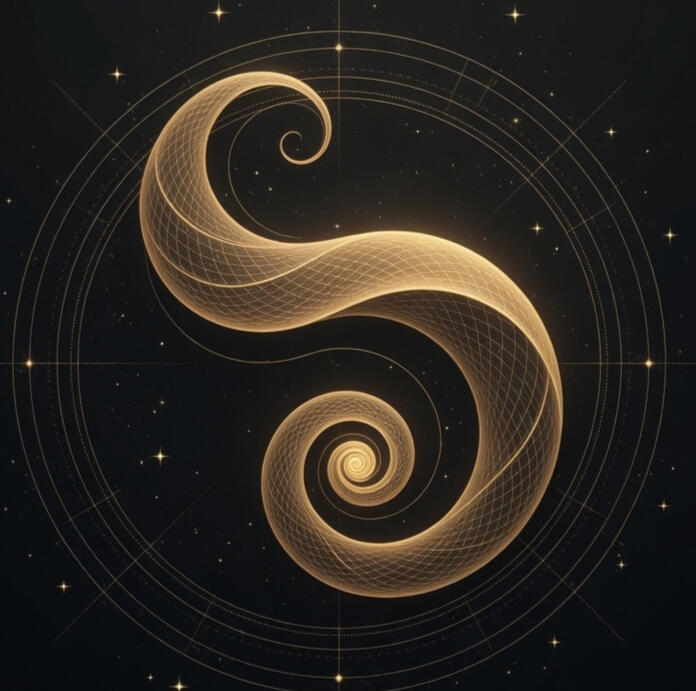
The TOTA framework constitutes a foundational, first-principles paradigm replacement for General Relativity (GR) and standard cosmological framework. Unlike conventional alternative models that offer incremental corrections to existing gravitational formalism or patch individual cosmological anomalies, TOTA resolves the century-long foundational crisis of fundamental physics by correcting a single core epistemic and ontological error: the reification of abstract spacetime coordinate geometry into a physical cosmic substrate. For over a century, mainstream physics has operated on an unvalidated axiom, treating the four-dimensional spacetime metric as a deformable, interactive physical entity despite lacking rigorous first-principles definition of space and time, no mechanical derivation of spacetime curvature, and no empirical isolation of spacetime as an independent substance. GR’s predictive success is purely local and mathematical, rooted in data fitting rather than causal physical mechanism, and its inherent circular causality—where mass-energy defines curvature and curvature governs mass-energy motion—renders it structurally incapable of universal scale description.
We are not here to draw better lines on the old map. We are here to explore the living territory beneath it.TOTA is the first physics of why.
Where spin is the source of motion.
Where the “stage” itself is a self-winding continuum.
This is not a new model of the cosmos. It is the cosmos revealing its true nature.
The messengers are here.
We are learning to listen.
Welcome to the other side of the sky.
The discovery of the interstellar object 3I/ATLAS presents a significant challenge for contemporary cometary science. Its trajectory, coma morphology, jet behavior, and non‑gravitational acceleration together exhibit a combination of properties that are difficult to reconcile within the standard cometary framework. Rather than treating these features as unrelated anomalies, we examine whether they may instead reflect a coherent dynamical signature of an interaction not currently parameterized in conventional models.
The coordinated anomalies of 3I/ATLAS suggest an interaction not described by
standard gravitational and sublimation-driven physics.
This points to an interaction with a large-scale, structured environment.
A fundamental source for such structure is the solar system's own dynamics.
As the Sun moves, it traces a helicoidal trajectory defined by the Milky Way's gravitational field and the total angular momentum of its planetary system. This collective motion inherently carries rotational degrees of freedom.
We propose that these degrees of freedom manifest as a coherent, heliospheric-scale structure—a Solar Torque-Spin Field (STSF). In this framework, these rotational degrees of freedom manifest as a coherent heliospheric structure—a Solar Torque‑Spin Field (STSF)—and 3I/ATLAS is interpreted as an object being entrained by this field;
its trajectory and activity are shaped by the same rotational dynamics
that govern the solar system’s own path through space.General Relativity successfully describes gravitational interactions as spacetime curvature, but it has no conceptual framework for torque‑spin—a dynamical property linked to rotational degrees of freedom. The system‑scale coherence of 3I/ATLAS suggests that rotational degrees of freedom may play a role in large‑scale solar‑system dynamics that pure curvature‑based models cannot capture. The STSF is introduced here as a phenomenological construct that encapsulates this collective rotational imprint, providing a single mechanism for 3I’s trajectory guidance, jet alignment, and nucleus coherence without requiring ad‑hoc compositional assumptions.
We introduce the Torque‑Entrained Interstellar Object (TEIO) model, in which 3I/ATLAS couples to a Solar Torque-Spin Field (STSF)—a heliospheric field structure generated by the Sun’s rotation. Within this framework, the object’s coherent dynamics—including fixed jet orientation, entrained trajectory, and preservation of nucleus integrity—are interpreted as manifestations of torque-spin field entrainment rather than conventional volatile sublimation. The model further proposes that orbital inclination relative to the solar system’s invariable plane governs the strength of torque-spin coupling, offering a unified explanation for the distinct behaviors of 1I/‘Oumuamua, 2I/Borisov, and 3I/ATLAS. The persistence of global coherence without correlated mass loss or fragmentation through this encounter would strongly favor the TEIO framework, while rapid loss of halo coherence or the emergence of multiple nuclei would support conventional sublimation‑driven scenarios. Thus, the object’s dynamical outcome—whether torque-spin entrainment leads to extended Jovicentric confinement (“capture”) or a deterministically modified hyperbolic escape—will serve as a decisive empirical test among competing interpretations. Observational confirmation of a new, Jupiter‑directed jet following the L₁ passage would provide particularly strong support for the torque-spin‑coupling hypothesis.
A permanently archived version of this preprint is available at Zenodo: https://doi.org/10.5281/zenodo.18154788
The persistence of global coherence without correlated mass loss or fragmentation through this encounter would strongly favor the TEIO framework, while rapid loss of halo coherence or the emergence of multiple nuclei would support conventional sublimation‑driven scenarios. Thus, the object’s dynamical outcome—whether torque-spin entrainment leads to extended Jovicentric confinement (“capture”) or a deterministically modified hyperbolic escape—will serve as a decisive empirical test among competing interpretations. Observational confirmation of a new, Jupiter‑directed jet following the L₁ passage would provide particularly strong support for the torque-spin‑coupling hypothesis.
A permanently archived version of this preprint is available at Zenodo: https://doi.org/10.5281/zenodo.18058232
https://doi.org/10.5281/zenodo.18058232
Torque‑Entrained Navigation of 3I/ATLAS: Empirical Validation via Lunar‑Proxy and Predictions for the Sun–Jupiter Field Confluence Zone Passage
VPAC
Witness the cosmos cast its verdict on General Relativity.
Spin Dictates Motion
The cosmos writes its secrets in motions we have not yet learned to read.
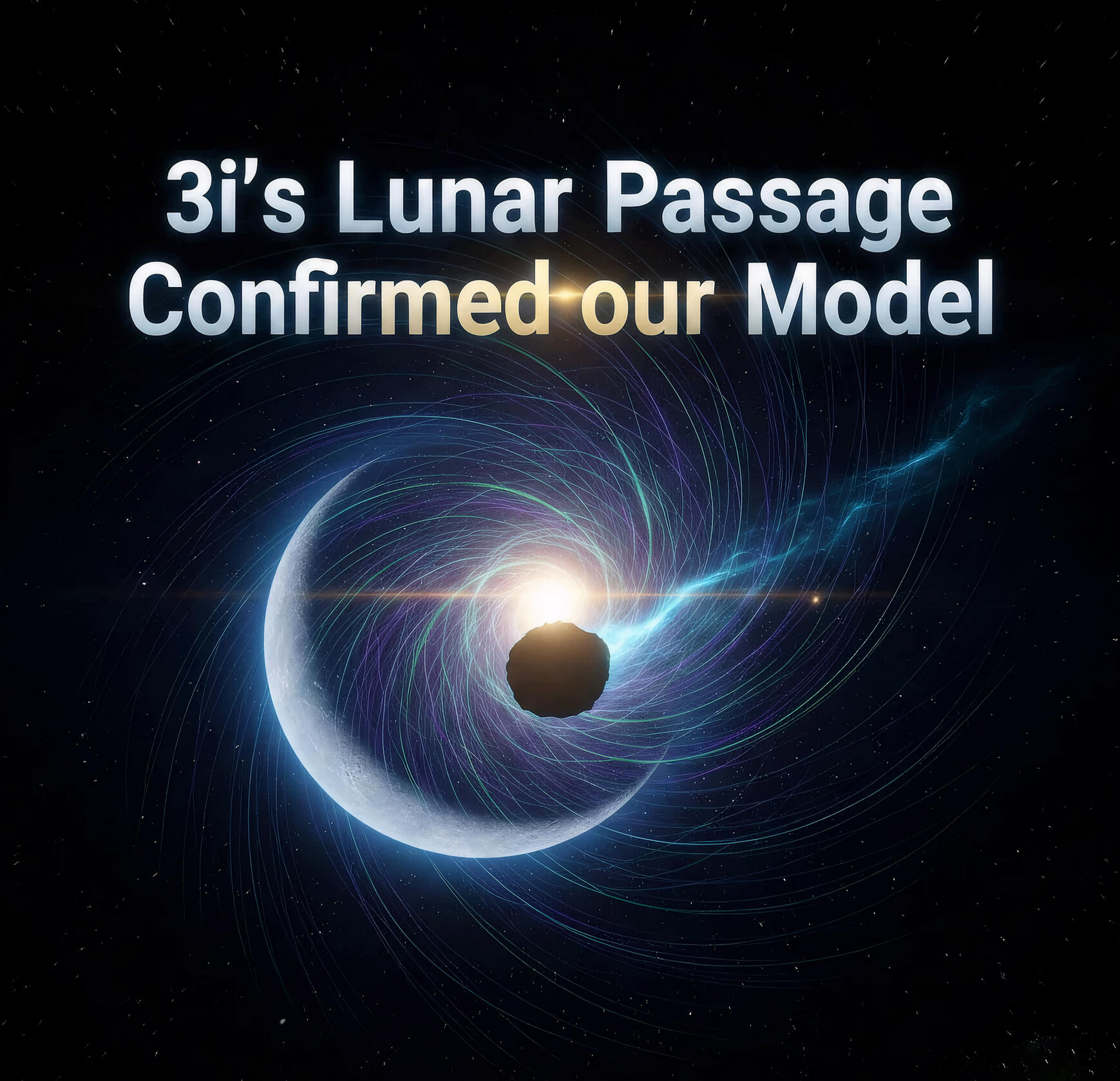
Spirals Write the Script
Beneath the geometry lies the current we are only beginning to feel.
The cosmos was never a static container. It was never a silent stage. It is a living ocean—braided, helical, turbulent—and only now, with interstellar messengers crashing through our solar systemand technology finally catching up to the surf around us, do we begin to glimpse the currents that were always there.
Until now. Because sometimes…the waves reach the shore. Sometimes the deep currents send something crashing into our quiet little system—a splinter of another star, a comet from another sun, a messenger from the vast, living ocean beyond.
These are the interstellar objects. And they are the first ripples of a much larger truth.
Copyright © TOTAFRAMEWORK, 2025
Thank you
Feugiat accumsan aenean sit col sem volutpat magna sem consequat.